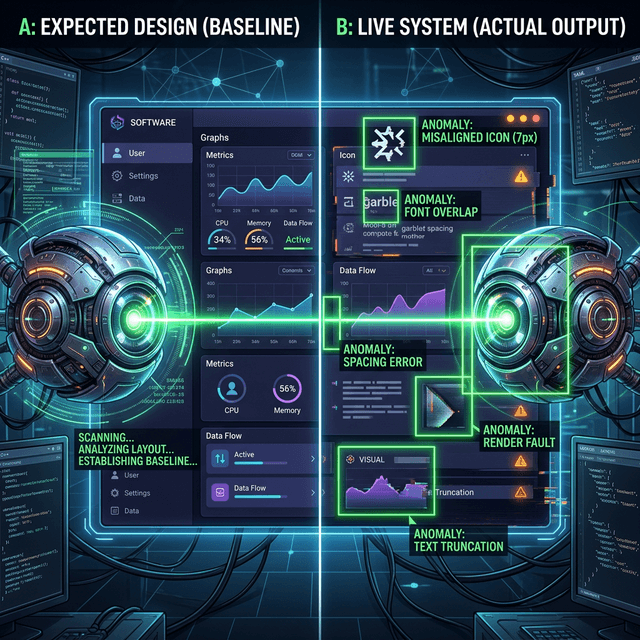
AI-Augmented Visual Regression: Beyond Pixel Matching
For years, visual regression testing has been a double-edged sword. Tools like Playwright's native `toHaveScreenshot()` compare an old baseline image with a new image pixel-by-pixel. It catches visual bugs perfectly, but it also creates thousands of false positives.
A font rendering update in Chrome? Test fails. A 2px padding change approved by design? Test fails. Dynamic timestamp on the dashboard? Test fails. Enter the era of Vision Language Models (VLMs).
The Flaw with Pixel-Diffing
Computers don't see buttons or text; they see RGB values. When doing a pixel-to-pixel comparison, the computer lacks semantic understanding of the UI. If a user profile image changes because the mock data rotated, a pixel-diffing algorithm flags it as a critical failure because 60% of the pixels in that quadrant changed color.
Human QA engineers don't look at pixels. They look at layout, structure, and readability. AI brings this human-like perception to automated testing.
How VLMs (GPT-4o, Claude 3.5 Sonnet) Change the Game
Semantic Evaluation
Instead of asserting `expect(page).toHaveScreenshot('home.png')`, you capture the image and pass it to a VLM with a prompt: "Does the hero section text overlap with the primary call-to-action button?" The AI evaluates the image based on human visual constraints.
Dynamic Data Tolerance
A graph with dynamic data points will fail a pixel test. An AI can be instructed: "Verify the sales chart is rendering and has x and y axes visible. Ignore the specific data line plot." This allows robust structural testing even with highly stochastic data.
Conclusion
Pixel diffing will still exist for strict component libraries (like Shadcn or Material UI) where precision is mandatory. But for End-to-End full page testing, sending screenshots to VLMs for structural and semantic validation will drastically reduce maintenance overhead and eradicate visual testing flakiness.
About the Author
Vishvas Dhengula — Lead SDET
Vishvas is a highly accomplished Software Development Engineer in Test (SDET) with 15+ years of experience architecting enterprise test automation frameworks for Fortune 500 companies across the United States and India. His expertise spans across a wide range of industry-leading automation tools, including UFT, Selenium, Cypress, Protractor, and Playwright.
Master AI Driven Architecture
Want to learn how to integrate GPT-4o Vision API directly into your Playwright assertions? Explore our advanced AI modules.