Scaling AI Automation with Semantic Discovery & WebMCP
Traditional QA automation is brittle. It relies on fixed selectors and predefined flows that break the moment a UI changes. But what if your automation could understand the page like a human? This is the promise of Semantic Discovery and WebMCP.
What is Semantic Discovery?
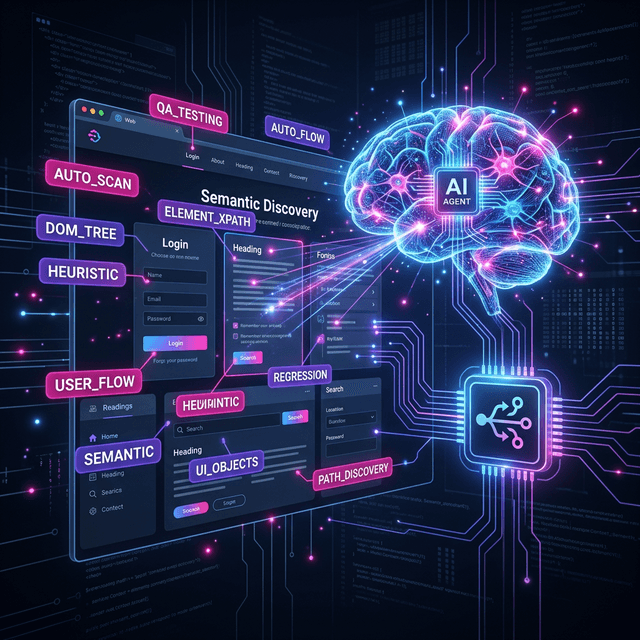
Semantic Discovery is the process of using AI to scan a web application and build a map of its capabilities—not just its HTML tree, but its meaning. Instead of looking for `id="btn-041"`, the AI looks for "The button that initiates the checkout process."
In our `inner-event` project, we've implemented a Discovery-First approach. Before the AI tries to run a test, it crawls the site to build a 'Semantic Sitemap.' This map allows the AI to recover automatically if a button moves or changes its ID.
WebMCP: The Polyfill for Agentic Excellence
Eliminating Vision Bottlenecks
Vision-based agents (reading screenshots) are slow and expensive. WebMCP acts as a high-speed data bridge, providing the LLM with structured DOM data and accessibility trees directly, enabling near-instant reasoning.
Robust Self-Healing
When an execution phase fails, our Orchestrator engages a Feedback Agent. This agent analyzes the session logs, identifies the 'drift' in selectors, and updates the Semantic Map—all without human intervention.
Architecture of an Agentic Pipeline
To scale AI automation, we move from "scripts" to "pipelines." A modern pipeline consists of four distinct phases:
- Discovery: Mapping the application's semantic landscape.
- Planning: Generating a high-level strategy based on user goals.
- Exploration/Mining: Dynamically searching for the best interaction paths.
- Execution: Performing the task and asserting success.
The Future is Scriptless
By combining the Model Context Protocol with specialized discovery agents, we can build QA systems that are 100% reliable and require zero maintenance. The shift from "test engineer" to "agent orchestrator" is here.
Explore our Open Source Frameworks
Check out the Inner-Event project to see how we implement Semantic Discovery and self-learning loops in real-world automation.